
Cracked, sunken and scaling concrete
Concrete Repair & Replacement in Bloomington, IN
An honest look at what can be fixed and what needs to come out, with a written price for both.
- Estimates given on site after measuring, never as a phone guess
- Every part of the price on its own line, from tear-out to sealer
- Air-entrained mix on all outdoor slabs
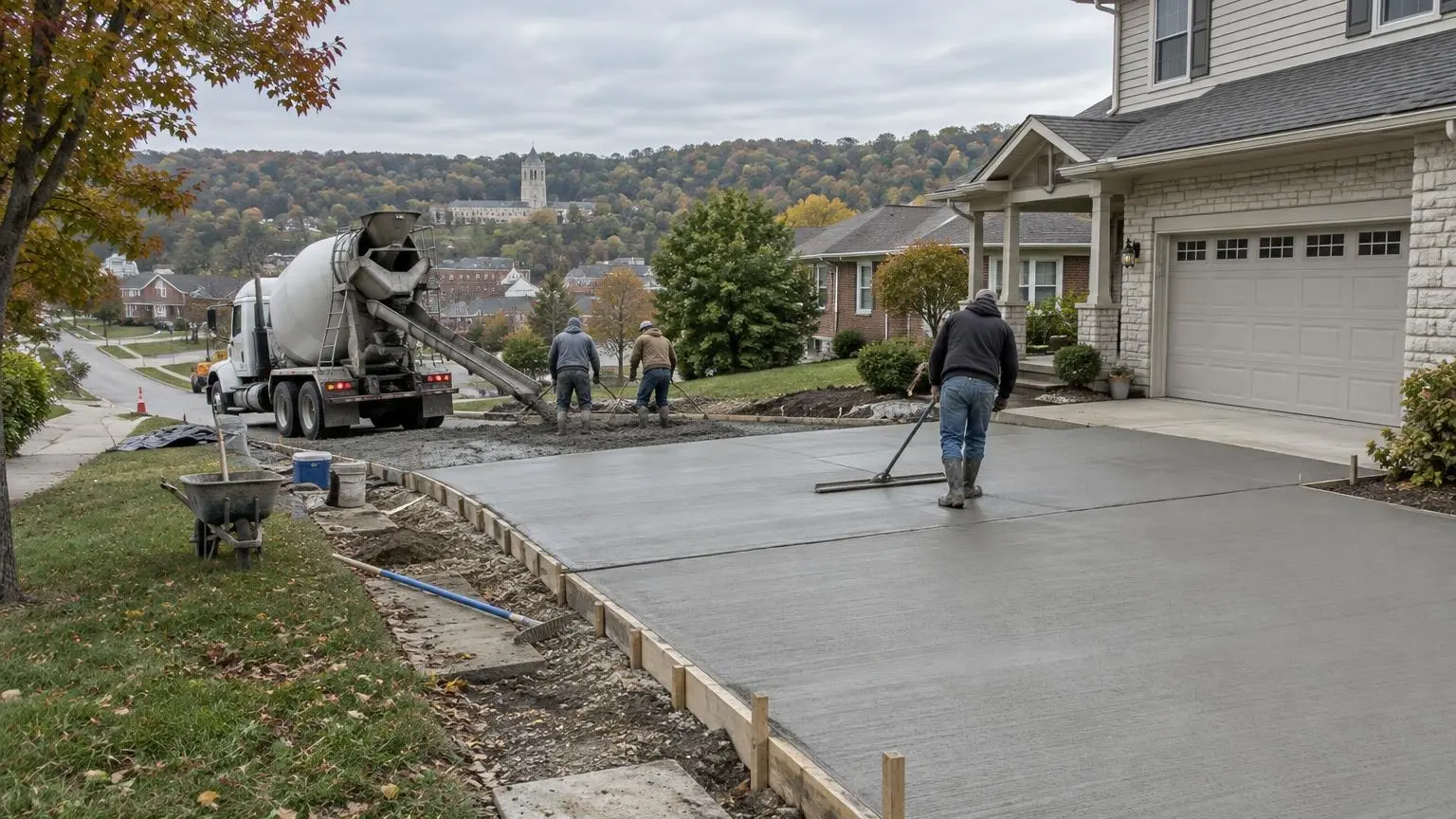
Fix It or Replace It: How We Decide
Concrete Repair & Replacement comes down to one question first: is the slab still sound? A slab that has dropped but stayed in one piece can often be raised. Narrow cracks can be sealed. A slab broken into many pieces, scaling across its surface or sitting on a washed-out base will keep failing no matter how often it is patched. We inspect the slab and what is beneath it, then give you a direct answer and a written price for each option that makes sense.
Why concrete fails in Bloomington
Three things wear out most local slabs. First, freeze-thaw. Bloomington's January daily mean is below freezing and the city gets nearly 50 inches of precipitation a year, so slabs freeze wet over and over. Older concrete poured without air entrainment scales and spalls. Second, salt, which speeds up that damage. Third, the ground. Bloomington is built on karst limestone, and a Purdue and Indiana highway research report on southern Indiana karst describes soil eroding into openings in the rock and causing subsidence. Poor compaction, downspouts dumping water at the edge, and tree roots do the rest.
Repair options
- Crack sealing: a flexible sealant pressed into cracks and joints so water stays out of the base
- Mudjacking: a cement-based grout pumped through small drilled holes to raise a sunken slab
- Foam lifting (polyjacking): expanding polyurethane injected through smaller holes, adding far less weight to the soil
- Resurfacing: a thin bonded overlay that hides light scaling on a slab that is still structurally sound
- Partial replacement: the worst panels saw-cut out and new ones poured, tied in with dowels
When replacement is the better call
HomeGuide's concrete leveling guide points to replacement when a slab has extensive cracking wider than about a quarter inch, significant surface damage or severe deterioration. We would add a few more: a slab broken into many small pieces, a base that has washed out or is full of roots, a driveway or walk that is too thin for its load, and slabs that have been leveled before and sunk again. In those cases, repair money tends to be spent twice.
Older housing, older slabs
Point2Homes' summary of Census data puts Bloomington's median year built at 1985, with more than half of homes built before 1990 and 12.2% before 1940. Many of those homes still have their original driveways, walks and steps. Some are worth saving with leveling or crack repair; many have reached the end. We will tell you which is which, and if only part of a driveway or walk has failed, we can replace just those sections.
How replacement works
We saw-cut along joints so the removal line is clean, break out the failed concrete and haul it away. Then we fix the reason it failed: dig out soft soil, compact new stone, cut roots, and correct the grade or redirect downspouts. New concrete is air-entrained for outdoor use, reinforced and finished to match the old as closely as possible. New concrete will be lighter in color than weathered concrete at first; the difference fades over time.
Signs you need repair or replacement
- A driveway, walk or patio that has dropped at one end or at the joints
- Steps that have pulled away from the house
- Cracks that keep growing or that you can fit a coin in
- A flaking, pitted surface with stone showing
- Water pooling on the slab or running toward the foundation
- Gaps under the edge of a slab where soil has washed out
Preventing the next failure
Keep downspouts and sump discharge away from slabs. Seal cracks and joints so water stays out of the base. Reseal outdoor concrete every few years and avoid rock salt. Watch for small settlement and deal with it early, while leveling is still an option.
What Repair and Replacement Covers
We match the fix to the problem, from sealing a crack to replacing a full driveway.
Crack and joint sealing
Cleaned and sealed with flexible sealant to keep water out of the base.
Slab leveling
Mudjacking or foam leveling to lift sunken walks, steps, patios and driveway sections.
Resurfacing
A thin overlay for light scaling on structurally sound concrete.
Section replacement
Saw-cut removal of failed panels with new concrete doweled into the old.
Full tear-out
Complete removal and replacement when the slab or base is past saving.
Drainage fixes
Regrading and downspout changes so the new concrete does not fail the same way.
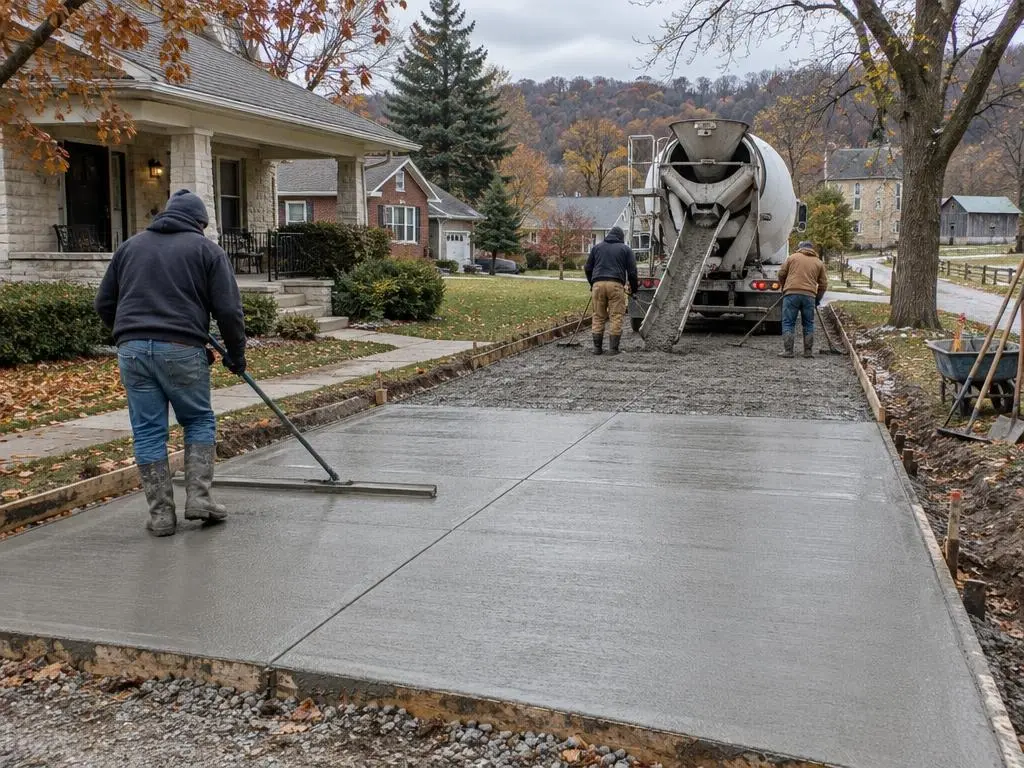
Typical Concrete Repair and Replacement Costs
| Work | Published range |
|---|---|
| Mudjacking, per square foot | $4 to $9 |
| Foam leveling, per square foot | $8 to $25 |
| Mudjacking a 100 sq ft sidewalk | $400 to $900 |
| Mudjacking a 450 sq ft driveway | $1,800 to $4,100 |
| Crack repair, per crack | $250 to $800+ |
| Resurfacing, per square foot | $3 to $7 |
| Replacement, per square foot | $6 to $15 |
National ranges from HomeGuide's concrete leveling and concrete sidewalk cost guides. The cause of the damage and what is under the slab change the total. Your written estimate is the price.
How Repair Work Goes
1. Inspect
We look at the cracks, settlement, surface and drainage, and probe for voids or soft base.
2. Recommend
You get a written price for repair and, where it makes sense, replacement, with our reasoning.
3. Fix the cause
Base, drainage or roots are dealt with before or during the repair.
4. Repair or replace
The slab is leveled, sealed, resurfaced or replaced, then cured and opened.
Concrete Repair & Replacement Questions
Can a sunken concrete slab be raised?
Frequently, if it is still in one piece. Mudjacking or foam lifting raises it back to level. HomeGuide's leveling guide prices mudjacking at roughly $4 to $9 per square foot and foam at $8 to $25.
Is it worth repairing concrete cracks?
Yes, if the slab is otherwise sound. Sealing keeps water out of the base, which slows freeze-thaw damage and settlement. Wide or growing cracks can be a sign of a bigger problem.
Why is my concrete flaking?
That is scaling. It usually traces back to freeze-thaw on concrete without air entrainment, a surface finished while bleed water was on it, or salt applied too early. Shallow scaling can be resurfaced; deep scaling generally means replacement.
Will new concrete match my old concrete?
Not right away. New concrete starts lighter and darkens as it weathers. Matching the finish texture and joint spacing helps it blend in sooner.
When is replacement better than repair?
When cracks run wider than about a quarter inch, the surface is badly damaged, the slab is in many pieces or the base has washed out. Patching those usually means paying for the same fix twice.
Concrete Repair & Replacement Service Areas
- Concrete Contractors in Bloomington, IN
- Concrete Contractors in Ellettsville, IN
- Concrete Contractors in Smithville-Sanders, IN
- Concrete Contractors in Clear Creek, IN
- Concrete Contractors in Harrodsburg, IN
- Concrete Contractors in Stinesville, IN
- Concrete Contractors in Unionville, IN
- Concrete Contractors in Bedford, IN
- Concrete Contractors in Oolitic, IN
- Concrete Contractors in Heltonville, IN
- Concrete Contractors in Mitchell, IN
- Concrete Contractors in Spencer, IN
- Concrete Contractors in Gosport, IN
- Concrete Contractors in Martinsville, IN
- Concrete Contractors in Paragon, IN
- Concrete Contractors in Morgantown, IN
- Concrete Contractors in Nashville, IN
- Concrete Contractors in Helmsburg, IN
- Concrete Contractors in Bean Blossom, IN
- Concrete Contractors in Bloomfield, IN
- Concrete Contractors in Solsberry, IN
- Concrete Contractors in Worthington, IN
Get a Concrete Repair & Replacement Estimate
Free inspections and written estimates for concrete repair and replacement in Bloomington.