
Backyard patios, pads and extensions
Concrete Patios in Bloomington, IN
Flat, dry outdoor space on sloped, shady and wooded lots, poured to shed water and last.
- Estimates given on site after measuring, never as a phone guess
- Every part of the price on its own line, from tear-out to sealer
- Air-entrained mix on all outdoor slabs
Outdoor Space That Works on a Bloomington Lot
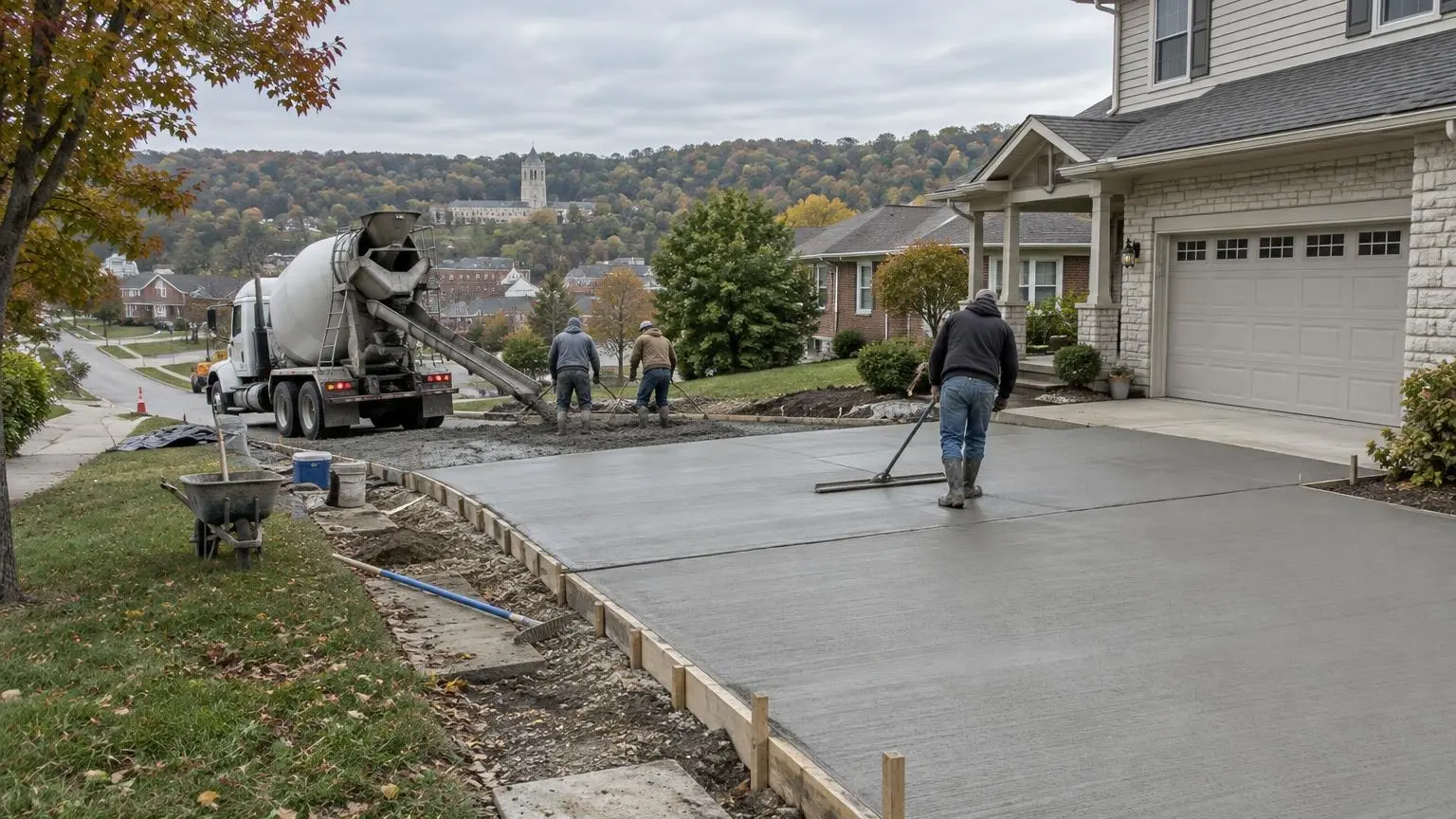
Concrete Patios turn a soggy corner of the yard into a place to eat, grill and sit outside from spring into late fall. In Bloomington the lot itself usually shapes the job more than anything else. Many yards slope toward or away from the house, sit under big oaks and maples, or have rock close to the surface. A good patio is planned around that: where water goes, what roots are in the way, and how the slab meets the back door.
Getting the size right
Work backward from the furniture. A two-seat table fits on roughly 10 by 10 feet. A full dining set with chairs pushed back wants something closer to 12 by 14. Once a grill, lounge seating or a fire ring joins the plan, 16 by 16 or even 20 by 20 feet fills up quickly. On the visit we stake the outline with you and check where the sun and shade fall at the hours you will be outside.
Plan the water before the concrete
The slab should fall away from the house at about 1/8 to 1/4 inch per foot so rain drains off instead of collecting against the foundation. Bloomington averages close to 50 inches of precipitation a year, so that pitch earns its keep. On hillside lots we might step the patio, add a low retaining edge, or shape the grade so runoff passes around the slab rather than across it. Water left standing on concrete in winter freezes in the surface, and that is the start of scaling.
What the job involves
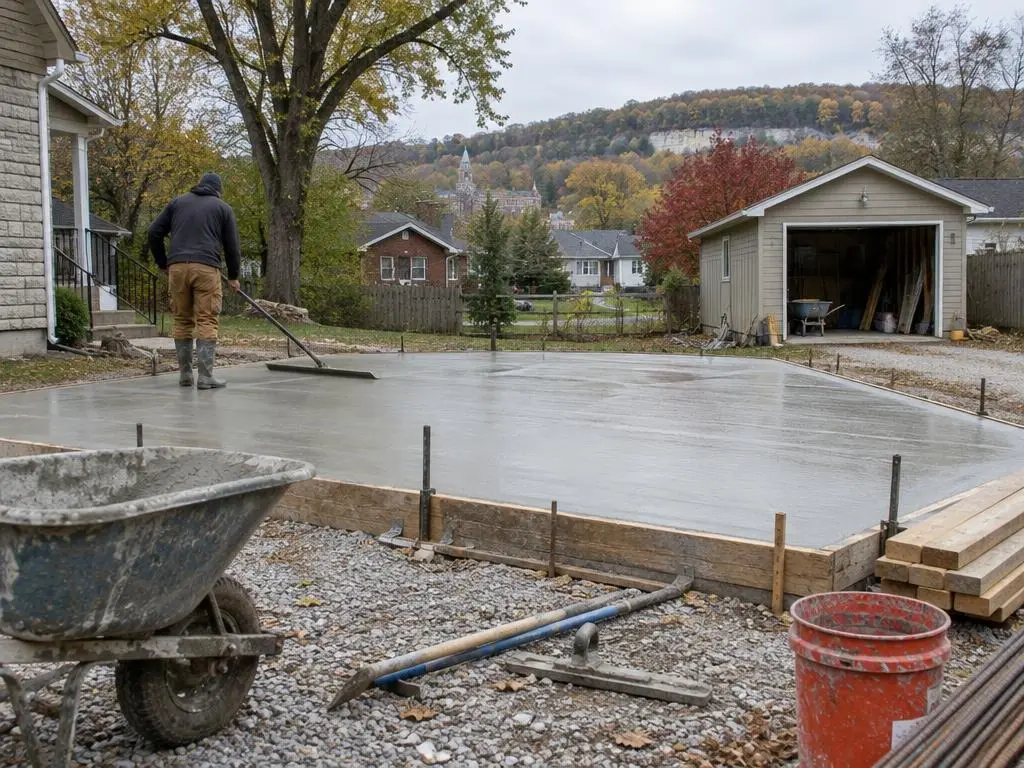
We strip sod and topsoil, cut roots that would push up the slab, and dig out soft soil. A compacted stone base goes down, then forms set to the finished height and slope. Reinforcement goes in. The concrete is placed, leveled, floated and finished, and control joints are cut so the patio cracks along straight lines instead of across the middle. Then it cures. A patio is usually poured in one day, with forms stripped the day after.
Finish options
- Broom finish: the standard, with good grip when wet
- Smooth or light broom: easier to sweep, better under furniture
- Exposed aggregate: shows the stone, hides dirt and has good traction
- Colored concrete: color mixed into the slab, or a stain on the surface
- Stamped: patterns like stone or slate, covered on its own service page
Signs an old patio should be replaced
- Low sections that hold puddles after a storm
- A slab tipping back toward the house
- Flaking or exposed stone over a wide area
- Roots heaving the edges or cracking the middle
- Not enough room for the way the yard gets used now
Extensions and add-ons
Many houses come with a small stoop-sized slab at the back door. That slab can be extended, but fresh concrete never fully bonds to old. We either drill and dowel the new section to the existing one or separate them with an isolation joint, and match the surface texture as closely as possible. Sometimes it is cleaner to remove the small slab and pour one continuous patio, and we price both ways. Fire pit pads, grill pads, hot tub pads and connecting walks are all part of the same work.
Patio upkeep
Sweep it, and hose it off a few times each season. Colored and decorative patios should be resealed every few years to protect the color and keep water out. Skip salt; sand near the door works for traction. Aim downspouts away from the slab and backfill any gaps that open along the edges so runoff cannot undercut the base.
What a Patio Job Covers
From the first layout to the finished slab, here is what goes into a patio.
Layout and grading
Outline, height at the door and slope away from the house set before digging.
Excavation and base
Sod, roots and soft soil removed and a compacted stone base placed.
Slab and joints
Reinforced concrete with control joints cut at planned spacing.
Finish
Broom, smooth, exposed aggregate or colored.
Extensions
New concrete tied to an existing slab with dowels or isolation joints.
Pads and paths
Fire pit, grill and hot tub pads, plus walkways to the patio.
Typical Concrete Patio Costs
| Patio | Published range |
|---|---|
| Plain concrete, per square foot | $4 to $12 |
| Exposed aggregate, per square foot | $7 to $18 |
| 10 x 10 ft, plain | $400 to $1,200 |
| 12 x 12 ft, plain | $600 to $1,700 |
| 16 x 16 ft, plain | $1,000 to $3,100 |
| 20 x 20 ft, plain | $1,600 to $4,800 |
| 20 x 20 ft, stained or stamped | $3,200 to $12,000 |
National ranges from HomeGuide's concrete patio cost guide. Slope, tree roots, access for the truck and the finish you choose change the total. Your written estimate is the price.
How a Patio Gets Built
1. Lay it out
We mark the size and shape, check the slope and talk through finish options.
2. Dig and base
Sod, roots and soft soil come out, and the stone base is compacted.
3. Pour and finish
Forms, reinforcement and concrete go in, the surface is finished and joints are cut.
4. Cure and use
Light foot traffic in a day or two, furniture after several days, sealing once it has cured.
Concrete Patios Questions
How much does a 12 by 12 concrete patio cost?
HomeGuide's national table lists a 12 by 12 foot patio at about $600 to $1,700 in plain concrete and $1,150 to $4,300 stained or stamped. Site prep and access shift that, so we price it after seeing the yard.
How long does a concrete patio last?
HomeGuide lists 30 to 50 years for concrete patios. A good base, proper slope and regular sealing are what get a patio to the long end of that range.
Can you pour a patio on a sloped yard?
Yes. We may cut into the slope, add fill and compact it in layers, step the patio, or add an edge to hold the grade. The plan depends on how steep the yard is and where water goes.
Can you build around a tree?
We can leave a ring around a tree, but cutting large roots can harm it, and roots can lift the slab later. We often suggest shifting the patio a few feet to give the tree room.
Is concrete or pavers better for a patio?
Poured concrete usually costs less per square foot and has no gaps for weeds. Pavers can be pulled up and reset if the ground settles. On a flat yard with good drainage, a well-built concrete patio is typically the simpler option.
Concrete Patios Service Areas
- Concrete Contractors in Bloomington, IN
- Concrete Contractors in Ellettsville, IN
- Concrete Contractors in Smithville-Sanders, IN
- Concrete Contractors in Clear Creek, IN
- Concrete Contractors in Harrodsburg, IN
- Concrete Contractors in Stinesville, IN
- Concrete Contractors in Unionville, IN
- Concrete Contractors in Bedford, IN
- Concrete Contractors in Oolitic, IN
- Concrete Contractors in Heltonville, IN
- Concrete Contractors in Mitchell, IN
- Concrete Contractors in Spencer, IN
- Concrete Contractors in Gosport, IN
- Concrete Contractors in Martinsville, IN
- Concrete Contractors in Paragon, IN
- Concrete Contractors in Morgantown, IN
- Concrete Contractors in Nashville, IN
- Concrete Contractors in Helmsburg, IN
- Concrete Contractors in Bean Blossom, IN
- Concrete Contractors in Bloomfield, IN
- Concrete Contractors in Solsberry, IN
- Concrete Contractors in Worthington, IN
Get a Concrete Patios Estimate
Free estimate visits for new patios, extensions and pads in Bloomington and the surrounding towns.