
New pours and full replacements
Concrete Driveways in Bloomington, IN
Poured to shed water, carry what you park and hold up to plows, salt and many freeze-thaw seasons.
- Estimates given on site after measuring, never as a phone guess
- Every part of the price on its own line, from tear-out to sealer
- Air-entrained mix on all outdoor slabs
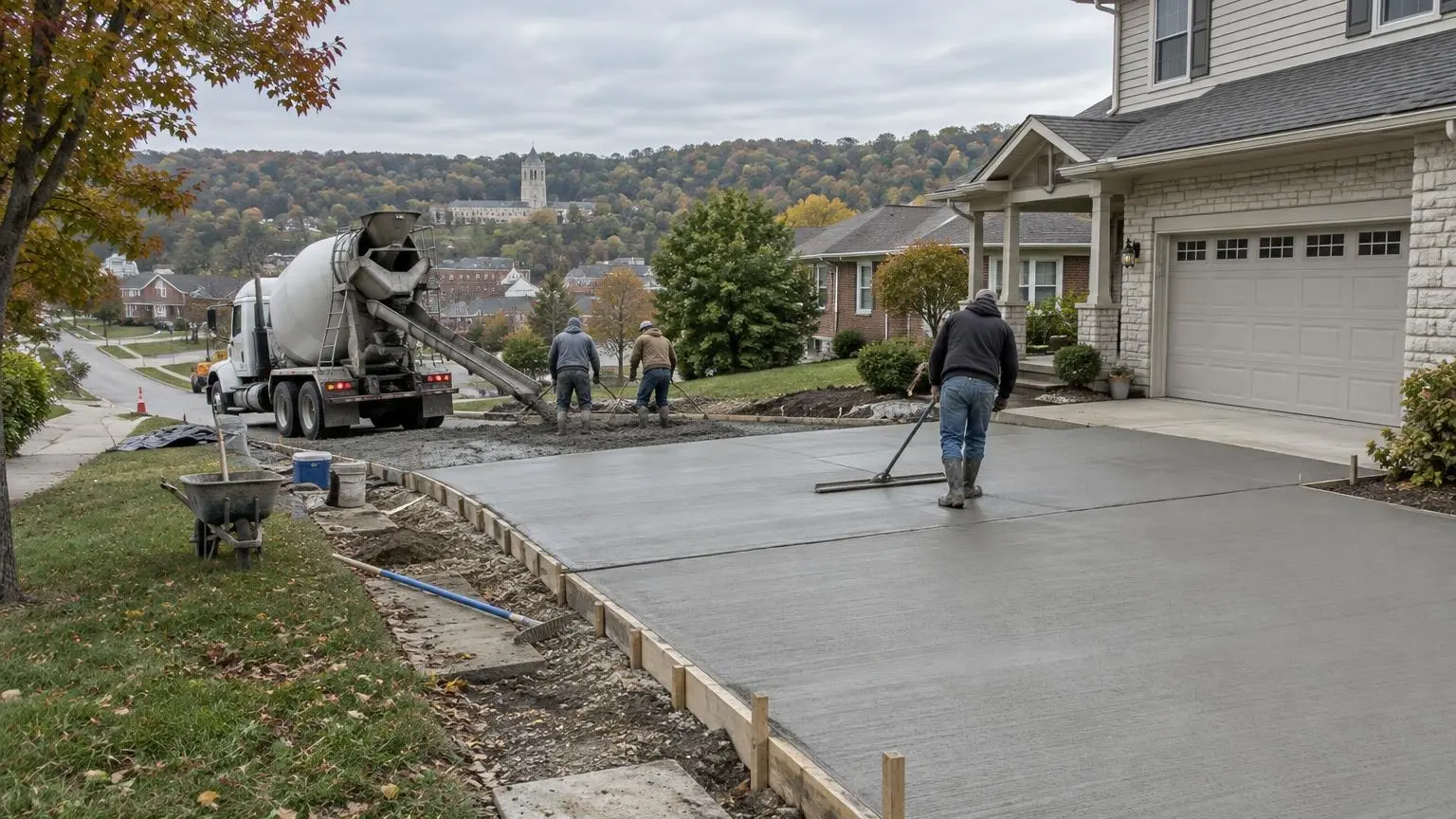
A Driveway That Lasts Through Bloomington Winters
A concrete driveway is the largest slab most Bloomington homes have, and it takes the worst treatment. It carries cars and delivery trucks, gets plowed and shoveled, and sits under salt and slush from December into March. Concrete Driveways that are poured right can last for decades here. Ones poured thin, on a poor base or without air entrainment start scaling and breaking up in a handful of winters. Most of the difference is in work you never see once the slab is done.
From tear-out to finished slab
The job opens with demolition: old concrete, asphalt, gravel or turf is broken up and hauled off, which HomeGuide prices at roughly $2 to $6 per square foot. We then excavate to the depth the base calls for, remove organic or spongy soil, and bring in crushed stone that gets compacted one lift at a time. Grade stakes set a fall that carries rain off the slab and away from the garage door and foundation. After that come the forms and steel, then the concrete is placed, struck off, floated and broomed. Joints are tooled or saw-cut, and curing starts right away.
Depth and steel
Per HomeGuide, a home driveway should be no thinner than 4 inches for ordinary cars and 5 to 6 inches where RVs or other heavy vehicles park, with edges thickened to 6 to 8 inches. Going to 6 inches raises the price to roughly $8 to $20 per square foot in that guide. It pays off if a camper, a work pickup, a trailer or regular delivery trucks will use the drive. HomeGuide adds about $1 to $3 per square foot for rebar. How much steel goes in depends on the loads and the soil at your address.
Why winter is the real test
Bloomington averages 49 inches of precipitation a year and a January daily mean below freezing. Water soaks into a driveway and freezes in the pores. Air-entrained concrete has tiny, evenly spaced air bubbles that give that ice room to expand. Without it, the top layer pops off in flakes. Salt speeds that up. So every driveway we pour is air-entrained, cured properly and sealed once it is ready, and we tell you how to care for it the first winter.
When a driveway is due for replacement
- Slabs that have dropped, tipped or risen at the joints
- Cracks you can slide a coin into, or ones that reopen after every patch
- Large patches of flaking or pitting with stone exposed
- Puddles on the surface, or runoff heading for the garage or house
- Earlier patches or overlays coming loose
- A drive that is too short or too narrow for today's vehicles
Older lots and long rural drives
Point2Homes' Census summary shows about 12% of Bloomington homes dating to 1939 or before, and older lots often come with narrow drives, shared aprons or a climb up from the street. County drives tend to be long and wind up wooded hillsides. In both cases the plan has to cover drainage, the transitions in slope and the line where city right-of-way begins. Within city limits the street apron usually calls for a right-of-way permit, filed through Civic Access. We confirm what your address needs and handle it.
Surface choices
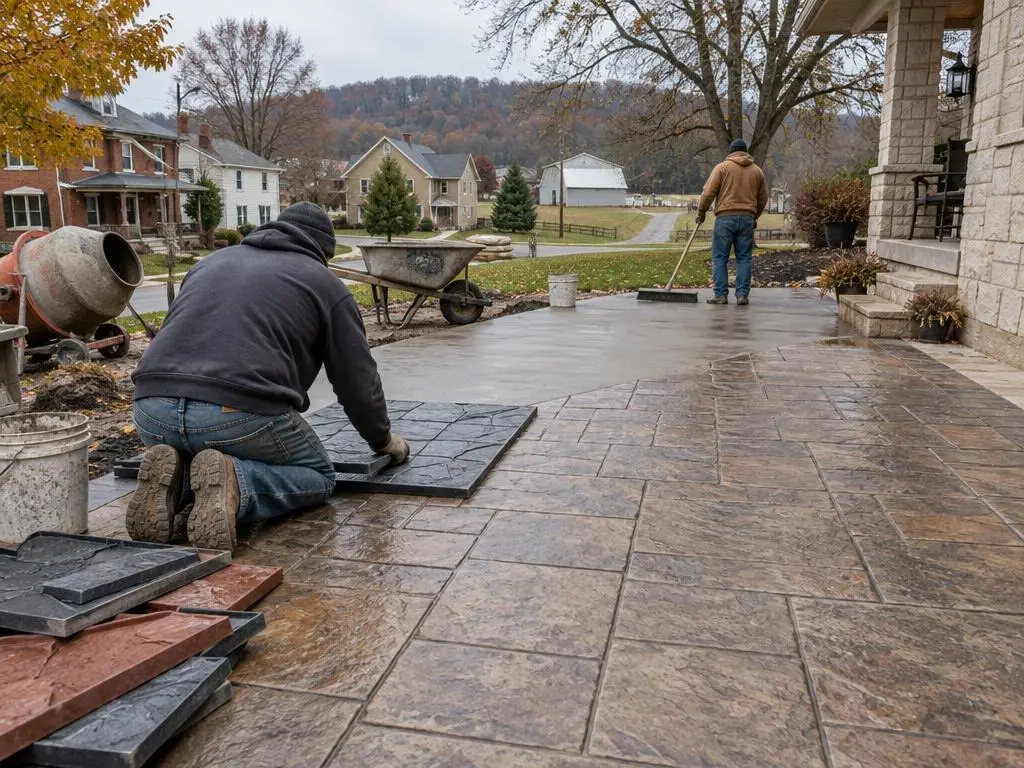
A broom texture is the default because it gives tires and boots traction in rain and ice. Exposed aggregate reveals the stone inside the mix and disguises tire marks well. Integral color or a stamped band can dress up the edges or the apron. A fully stamped driveway is possible, but stamped texture can be slicker when icy, so we generally recommend keeping the wheel paths broomed.
The first year with a new driveway
Keep vehicles off for roughly seven days. Skip rock salt the first winter and use sand if you need grip. Apply a penetrating sealer every few years. Seal cracks as soon as they appear so water stays out of the base. A plastic shovel edge, or a plow blade set a little high, protects the finish.
What a Driveway Job Covers
Every driveway estimate covers the full sequence, from breaking out the old surface to sealing the new one.
Tear-out and haul-off
Old concrete, asphalt or gravel broken up and removed from the site.
Base and grading
Soft soil dug out, crushed stone compacted in layers and the grade set to drain away from the house.
Reinforced slab
Rebar or mesh sized to the load, with thicker slabs and edges where heavy vehicles park.
Approach and apron
The section from the street to the garage, including the right-of-way permit when the city requires one.
Joints and finish
Control joints at planned spacing and a broom, exposed aggregate or colored finish.
Sealing
A penetrating sealer applied after curing to slow water and chloride absorption.
Typical Concrete Driveway Costs
| Driveway | Published range |
|---|---|
| Per square foot, 4-inch slab | $6 to $15 |
| One-car, 12 x 24 ft (288 sq ft) | $1,700 to $4,300 |
| Two-car, 20 x 20 ft (400 sq ft) | $2,400 to $6,000 |
| Two-car, 24 x 24 ft (576 sq ft) | $3,500 to $8,600 |
| 6-inch slab, per square foot | $8 to $20 |
| Old driveway removal, per square foot | $2 to $6 |
| Sealing, per square foot | $1 to $3 |
National ranges from HomeGuide's concrete driveway cost guide. Bloomington prices can differ, and tear-out, slope, access, thickness and finish all change the total. Your written estimate is the price.
How a Driveway Gets Built
1. Site visit
Measurements, slope and drainage checks, a look at the soil and old slab, and a permit check for your address.
2. Demolition and base
The old surface is hauled away, soft soil is replaced, and crushed stone is compacted and graded.
3. Pour day
Forms and steel are set, air-entrained concrete is placed and broomed, and joints are cut.
4. Cure, then seal
Traffic waits until the slab has cured, and sealer goes on once it is ready.
Concrete Driveways Questions
How thick should a concrete driveway be?
HomeGuide gives 4 inches as the minimum for passenger cars and 5 to 6 inches for RVs and other heavy vehicles, plus thicker edges. We choose the depth from what you park and how firm the ground is.
Rebar or wire mesh for a driveway?
Both help hold cracks together; neither stops them. Rebar, set at the right height on supports, adds more strength and suits heavier loads. We recommend reinforcement based on the slab size, load and soil.
How long until I can park on my new driveway?
Plan on about a week for cars, longer for heavy trucks and campers. Cooler weather slows curing, so fall pours can need more time.
Can you pour over my old driveway?
Rarely. A new layer over a broken or sunken slab inherits the same cracks and raises the height at the garage door. Taking the old slab out lets us fix the base it failed on.
Do I need a permit for a new driveway in Bloomington?
Inside city limits, work in the right-of-way, like the approach from the street, goes through the city's Civic Access portal, and the city lists a fee for residential driveway installation. We check your address and handle it.
Concrete Driveways Service Areas
- Concrete Contractors in Bloomington, IN
- Concrete Contractors in Ellettsville, IN
- Concrete Contractors in Smithville-Sanders, IN
- Concrete Contractors in Clear Creek, IN
- Concrete Contractors in Harrodsburg, IN
- Concrete Contractors in Stinesville, IN
- Concrete Contractors in Unionville, IN
- Concrete Contractors in Bedford, IN
- Concrete Contractors in Oolitic, IN
- Concrete Contractors in Heltonville, IN
- Concrete Contractors in Mitchell, IN
- Concrete Contractors in Spencer, IN
- Concrete Contractors in Gosport, IN
- Concrete Contractors in Martinsville, IN
- Concrete Contractors in Paragon, IN
- Concrete Contractors in Morgantown, IN
- Concrete Contractors in Nashville, IN
- Concrete Contractors in Helmsburg, IN
- Concrete Contractors in Bean Blossom, IN
- Concrete Contractors in Bloomfield, IN
- Concrete Contractors in Solsberry, IN
- Concrete Contractors in Worthington, IN
Get a Concrete Driveways Estimate
Free estimate visits for new and replacement driveways across Bloomington and Monroe County.